
For most of the past two decades, grid reliability was a line item few North American plant managers budgeted for seriously. That has changed. In 2026 the conversation inside manufacturing facilities from Ohio to Texas is no longer whether the grid might dip — it is how long your line stays down when it does, and what that hour costs.
This guide explains what has actually changed on the North American bulk power system, what a grid event costs an industrial operation, and how to specify an industrial standby generator that is compliant, correctly sized and deliverable for the U.S. and Canadian market this year.
Why grid reliability became an industrial planning issue in 2026
Three signals matter to a plant engineer.
1. Regulators now flag much of the continent as at-risk. NERC’s 2025 Long-Term Reliability Assessment, released in January 2026, places 13 of 23 North American assessment areas at elevated or high resource-adequacy risk over the next five years — including MISO, PJM, the Texas RE-ERCOT region and parts of the Western and Southeastern interconnections. The same assessment cycle points to more than 105 GW of peak seasonal generating capacity potentially retiring over the next decade.
2. Operators came close to controlled outages this summer. In July 2026 the Southwest Power Pool, the grid operator for 14 central U.S. states, issued a Level 3 energy alert after several plants tripped offline during a heat wave, leaving reserve margins thin from North Dakota to Louisiana. Rolling blackouts were avoided — but the alert is the clearest recent signal of how little headroom some regions now carry.
3. Capacity has repriced, and industrials pay for it. PJM’s capacity market cleared at $28.92/MW-day for delivery year 2024/25 and $329.17/MW-day for 2026/27 — roughly a tenfold move — with the 2027/28 auction clearing at the FERC-approved cap of $333.44/MW-day. Capacity costs flow through to retail rates, and electricity-intensive industrial tenants absorb a disproportionate share.
At the same time, U.S. electricity load is forecast to grow 1.9% in 2026 and 2.5% in 2027, concentrated in Texas and the mid-Atlantic. Demand is rising faster than always-available supply.What a grid event actually costs a manufacturing plant
The accounting is uncomfortable but simple. A voltage sag or a multi-hour outage does not just pause production:
Batch and work-in-process loss in process industries, where an interrupted cycle is scrap, not inventory.
Restart and re-qualification time on lines that cannot simply be switched back on.
Idle labor and missed shipment penalties, which compound hour by hour.
Reputational cost when a customer’s line stops because yours did.
A correctly specified standby generator converts an unbounded production loss into a bounded, forecastable fuel cost. That trade is the entire business case for factory backup power.
Standby or prime: choose the duty rating before you choose the kW
The first specification decision is not power — it is duty. A standby rating suits plants with a reliable utility connection that need backup during outages. A prime rating suits sites with no utility, weak utility, or expected extended runtime. Confusing the two is the most common way a generator package ends up under-built for its real job. We cover the distinction in detail in our guide to prime power vs standby ratings.
Sizing: the motor-starting load decides your frame size
Running kW is only half the calculation. The largest motor start on site — and the sequence in which loads pick up after transfer — sets the frame size, because starting inrush can be several times running current and drives allowable voltage dip. Our engineering note on factory standby generator sizing for motor starting loads walks through the method.
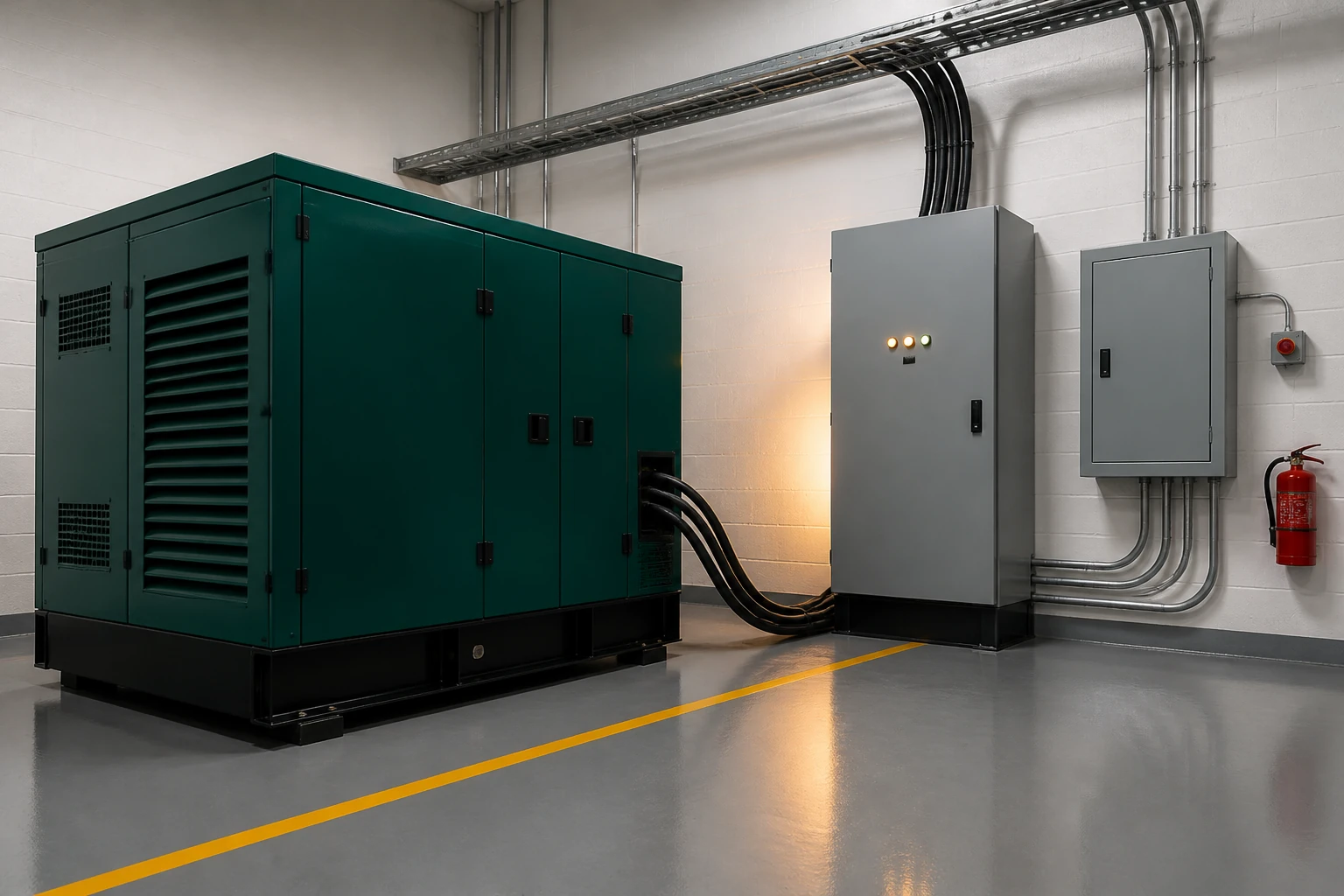
The transfer side matters just as much. The automatic transfer switch is what actually delivers generator power to the building, and its sizing follows NEC Articles 700, 701 and 702 depending on whether your loads are emergency, legally required standby, or optional standby.
Compliance and configuration for the U.S. and Canada
When you buy an industrial standby generator for a North American site, verify these five items in writing:
Frequency and voltage. Standard 60 Hz / 480 V configuration for the U.S., Canada and Latin America.
Emissions. EPA Tier 4 Final options (and EU Stage V where applicable), documented for the Americas.
Acceptance testing. A load bank test is the only way to prove a set carries its rated load; see our explainer on NFPA 110 load bank testing. Every ECG Power set runs a 100% full-load factory test for more than 10 hours before shipment, with the report included.
Control and transfer. Controller choice (Deep Sea or ComAp) and ATS matched to your load classes.
Quality system. ISO 9001 manufacturing, with CE, RoHS and UKCA documentation.
What ECG Power supplies
ECG Power manufactures diesel generator sets from 10 to 1,800 kW, factory-direct from Fujian, China, since 2004, exporting to more than 160 countries since 2010. Sets integrate Cummins, Isuzu and Weichai engines with Stamford and Leroy-Somer alternators, in open or soundproof canopy, plus mobile and trailer-mounted models. Every set carries a one-year or 1,000-hour warranty and 7×24 remote support.
Operating cost is part of the specification too — our guide to diesel generator fuel consumption per hour and cost per kWh shows how to model it against your expected runtime.
How ECG Power delivers: from inquiry to delivery in four steps
Consultation — our engineers analyze your load profile, site conditions and duty requirements.
Compliance match — we verify 60 Hz configuration and EPA Tier compliance for the Americas.
Customization — canopy style, ATS and control panel (Deep Sea or ComAp) matched to your spec.
Delivery and commissioning — international shipping coordinated, with remote or on-site commissioning.
FAQ
What size industrial standby generator does my plant need? Size follows your connected load profile and your largest motor start, not a rule of thumb. ECG Power covers 10–1,800 kW; send your load list and site conditions and our engineers will return a tailored specification within one business day.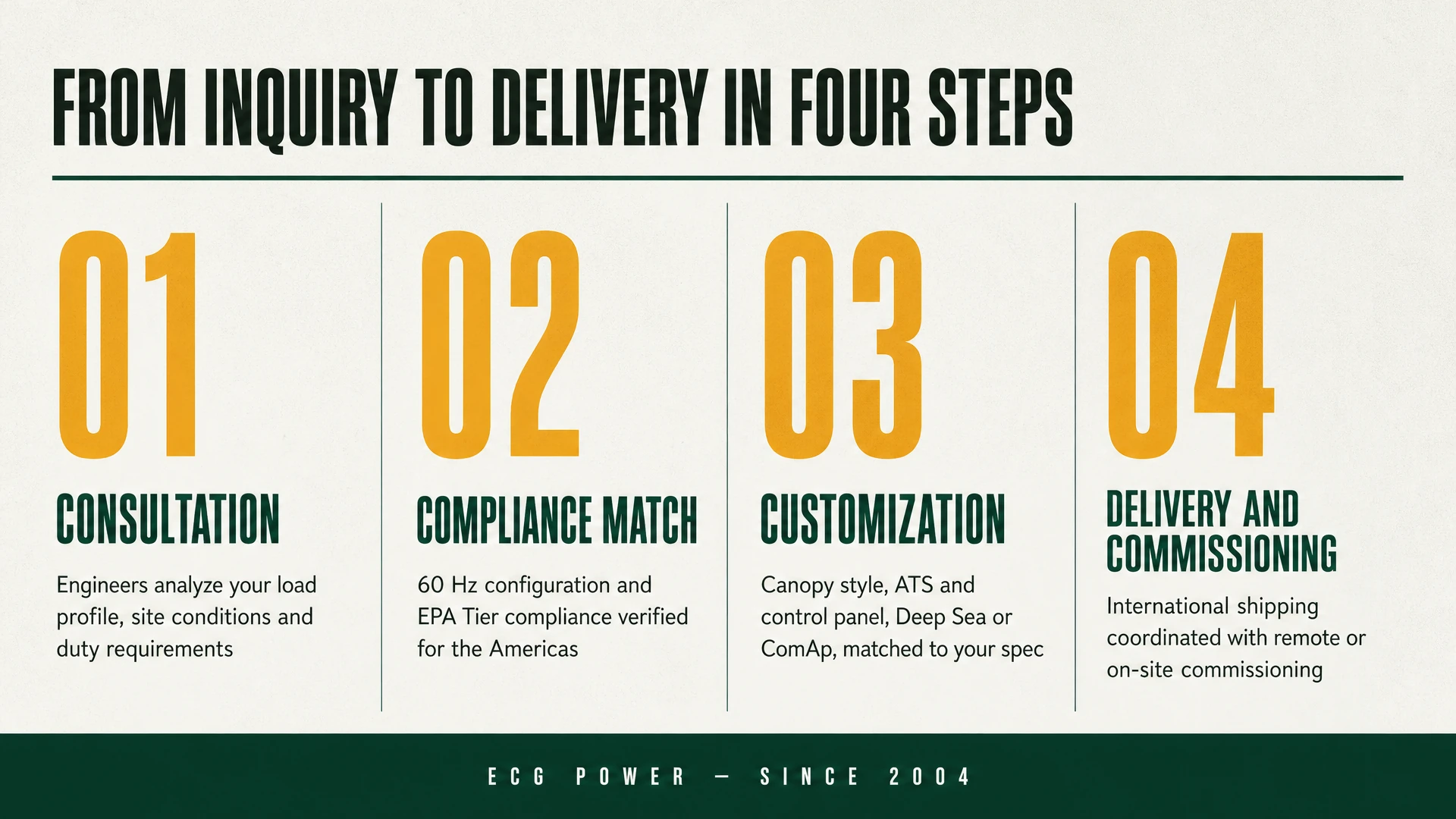
Are ECG Power generators compliant for the U.S. and Canadian market? Sets are available in standard 60 Hz / 480 V configuration, with EPA Tier 4 Final and EU Stage V options documented for the Americas, built under ISO 9001 and full-load tested before shipment.
How long does delivery take? Standard configurations can ship in weeks; custom engineered sets are confirmed at quotation.
What warranty and support are included? A one-year or 1,000-hour warranty from the date of shipment, free after-sales support for non-human issues in that period, and 7×24 remote diagnostics and genuine parts for the life of the set.
The bottom line
Grid headroom in North America is thinner than it has been in a generation, and the cost of that thinness is landing on industrial ratepayers first. The cheapest hour of downtime is the one your standby generator absorbs.
Tell us your load profile and site conditions — get a free sizing consultation and a tailored specification within one business day, or browse the full industrial diesel generator range. Email sales@ecgpower.com.
Sources
NERC, 2025 Long-Term Reliability Assessment (released Jan 29, 2026); summary via POWER Magazine.
NRECA on NERC retirement outlook (>105 GW peak seasonal capacity, Feb 2026).
Reuters, “Grid operator in US central states warns of potential rolling blackouts” (July 2026), via AJOT.
IEEFA on PJM capacity prices ($28.92 → $329.17/MW-day); PJM Inside Lines on the 2027/28 Base Residual Auction ($333.44/MW-day cap).
U.S. EIA, Today in Energy (March 2026) on 2026–2027 load growth.


